Why the largest fortunes are built around systems, not products.
Most investment analysis begins with what can be measured: revenue growth, margins, market share, cash generation and valuation. These questions are indispensable. They describe the visible economics of a business without explaining how long those economics can last.
Behind the products and financial statements lies an architecture — a system of rules, standards, relationships, interfaces and dependencies through which other participants must operate. Companies that build or control these architectures do not merely compete within markets. They organise them.
This matters because stock-market wealth creation is extraordinarily concentrated. Hendrik Bessembinder's century-long study of the US market found that 46 companies accounted for half of approximately $91 trillion in net shareholder wealth creation. The composition of those winners is revealing. They span technology, energy, finance, healthcare and consumer markets, and few remained simple product businesses. Apple, Microsoft, Nvidia, Amazon and Alphabet developed platforms around which customers and developers organised. Visa and Mastercard established the rules and connections through which payments moved. Walmart, Costco and Coca-Cola built procurement and distribution systems of exceptional scale. Exxon and Chevron combined access to resources with refining, logistics and infrastructure. Pharmaceutical leaders institutionalised scientific knowledge through research, patents, clinical development and regulatory capability.
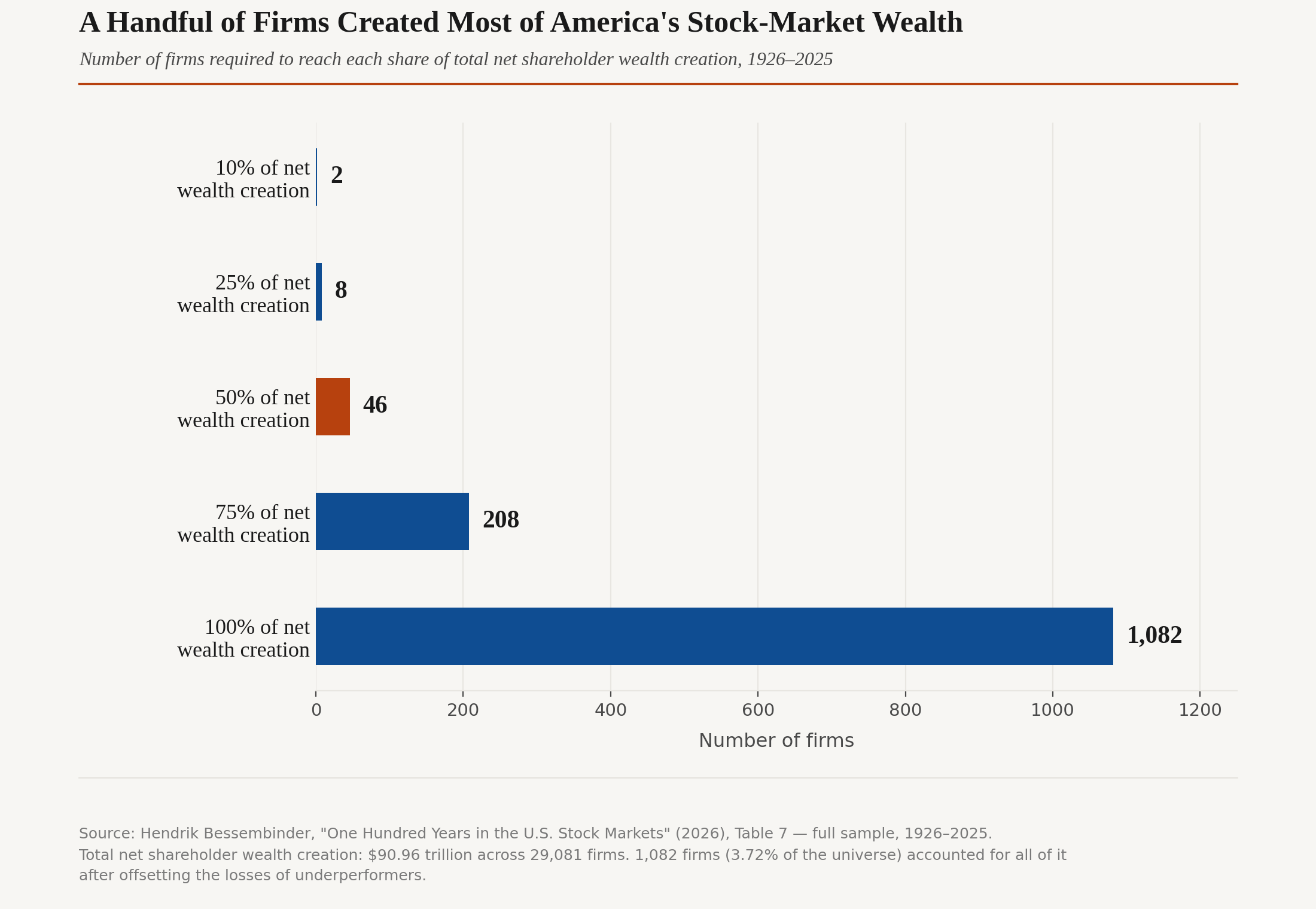
Source: Hendrik Bessembinder, "One Hundred Years in the U.S. Stock Markets" (2026), Table 7.
The industries differ. The pattern recurs: exceptional wealth was created when a successful product became the foundation of a platform, network, standard, distribution system, trusted institution or repeatable knowledge engine. Almost none of the 46 got there by making a better product and stopping.
The question is not why some companies grow. It is why a handful become so deeply embedded in economic activity that customers, developers, suppliers and competitors must organise themselves around them.
Valuation determines the price an investor should pay. Architecture determines how long the company's power will last.
Products change faster than the systems beneath them
Technology markets create an illusion of permanent upheaval. Products appear, dominate and disappear. Mainframes give way to personal computers, personal computers to cloud computing, cloud software to AI agents. Licensing gives way to subscriptions, subscriptions to usage-based pricing, and usage-based pricing may eventually give way to payment for completed outcomes.
At the surface, everything appears unstable. Underneath the turbulence, a smaller set of mechanisms repeatedly determines who accumulates power:
- Control of scarce resources
- Proprietary knowledge
- Coordination of fragmented participants
- Trust between parties that do not know one another
- Standards that make systems interoperable
- Dependencies that become expensive to replace
- The ability to adapt without destroying the existing ecosystem
The technologies change. These mechanisms recur.
Hormuz and Suez remain critical because geography concentrates physical trade through narrow, difficult-to-replace routes. The Strait of Hormuz carries roughly one-third of global seaborne crude oil trade, around one-quarter when refined products are included, and approximately 19% of global LNG. The Suez Canal normally handles 12–15% of world trade and about 30% of container traffic, worth more than $1 trillion annually. When Houthi attacks forced vessels around the Cape of Good Hope in 2024–25, Suez transits and tonnage collapsed. Even in a globalised economy, geography still creates chokepoints that no amount of capital can route around.
ASML matters because decades of accumulated knowledge, specialised suppliers and engineering capability have concentrated advanced lithography around an extraordinarily difficult technological chokepoint. Its machines combine Zeiss optics, Cymer light sources and thousands of precision components assembled through a supplier network built over roughly three decades. ASML controls the EUV lithography market and dominates lithography overall, making it the only company capable of supplying the equipment required for the most advanced chips. Its moat is not a patent or a product. It is an industrial system no competitor can reproduce quickly, and quickly is the only speed that would matter.
Visa sits at the centre of a vast payment network because it coordinates rules, institutions, merchants and consumers at enormous scale. In FY2025 it processed approximately 257.5 billion transactions representing $16.7 trillion in payment volume, supported by around 4.8 billion active credentials worldwide. Its advantage comes from a self-reinforcing two-sided network: merchants accept Visa because consumers carry it, consumers carry it because merchants accept it. Scale, trust, reliability and global acceptance create a network chokepoint that becomes harder to displace as it grows.
Microsoft's position is reinforced by the interaction of identity, productivity software, development tools and cloud infrastructure. Microsoft 365 has more than 400 million commercial seats. Azure accounts for roughly one-quarter of global cloud infrastructure. GitHub anchors developer workflows. Entra ID controls access across the broader enterprise environment. These are not four independent advantages. Each layer strengthens the others, increasing switching costs, expanding Microsoft's visibility across the organisation and turning an extensive product portfolio into a compounding platform chokepoint.
These businesses are very different. The sources of their power share a common structure.
The history of capitalism is a migration of control points
Economic power does not move through a clean sequence in which one source of advantage replaces another. It accumulates in overlapping waves.
Land, minerals and energy created resource power. Financial institutions developed the ability to aggregate savings, finance governments and underwrite industrial expansion. Information networks created advantages in commerce, banking and markets. Communication and payment systems generated network power. Digital platforms established rules, APIs, marketplaces and developer ecosystems. AI may now introduce another layer: adaptive systems that continuously sense conditions, make decisions and act.
Earlier sources of power do not disappear. Energy still matters. Capital still matters. Ownership still matters. What changes is the control point around which the next layer of economic activity must organise itself.
Standard Oil was not powerful because it had exposure to oil. Its advantage combined refining scale, transport economics, favourable railway arrangements, pipelines, logistics and distribution. Its architecture bundled several forms of control at once.
The Rothschild banking network derived its advantage from information speed, trusted family coordination across financial centres and the ability to distribute sovereign financing — not from possessing money, which many rivals also possessed.
Bloomberg did not become indispensable because financial data was scarce. It combined data, analytics, communications and professional workflow inside a system used continuously by market participants.
ARM does not manufacture most of the chips built on its technology. Its power comes from defining and licensing the processor architecture around which chip designers, manufacturers, software developers and device makers organise. By controlling a foundational design layer, ARM participates in the economics of an entire ecosystem without owning a single factory.
Great fortunes are rarely created by exposure to an era. They emerge when a firm controls a mechanism through which that era operates.
What is an architecture?
An architecture is the combination of rules, interfaces, incentives and dependencies through which participants interact.
TCP/IP provides rules for communication across networks. SWIFT provides the messaging rules that let banks settle cross-border payments. AWS transformed internal computing capabilities into reusable infrastructure accessed through standardised interfaces. Windows created compatibility around applications and enterprise workflows. CUDA connected chips to programming tools, libraries and developer knowledge.
An architecture becomes powerful when others build upon it.
A product is purchased. An architecture is incorporated into decisions, processes and investments. Customers train employees around it. Developers write software for it. Partners create complementary services. Regulators begin to recognise it. Replacing it requires changing not one contract but a web of habits, systems, skills and relationships.
That is why architectures outlast individual products.
Endurance is never automatic. Architectures survive only when they evolve, remain reliable and retain legitimacy.
Microsoft endured because it repeatedly adapted the system around which its customers operated — from desktop software to enterprise servers, cloud infrastructure, subscriptions and developer tools — without forcing the entire installed base to abandon it at once.
Nokia's mobile architecture followed the opposite path. Its scale, distribution and hardware expertise remained formidable, but Symbian became increasingly difficult for developers, manufacturers and users as the market shifted toward touch interfaces, application ecosystems and software-led experiences. What had once been an advantage became a constraint, and activity reorganised around iOS and Android.
The difference was not that one company innovated and the other did not. Microsoft kept repositioning its control point as the surrounding economy changed. Nokia remained committed too long to an architecture whose usefulness was eroding. A system that extracts excessive rents, neglects its users or prevents adaptation eventually invites substitution, regulation or revolt.
Knowledge becomes powerful when it is institutionalised
Physical assets depreciate and face capacity limits. Knowledge can be reused, recombined and distributed at low marginal cost.
But knowledge does not compound because a company employs intelligent people. It compounds when learning becomes embedded in the institution.
TSMC's advantage lies not only in its fabrication plants but in accumulated knowledge about process recipes, yields, materials, equipment and chip designs. Every production run generates learning that improves the next one, while close collaboration with customers allows manufacturing knowledge and product design to advance together.
Synopsys compounds knowledge through decades of semiconductor design software, verification methods, reusable intellectual property and integration with evolving industry standards. Each new generation of chips adds complexity to the tools and institutional expertise required to design the next.
SpaceX converts launches into cumulative engineering knowledge. Flight data, manufacturing experience, engine performance, recovery attempts and operational failures continuously feed back into vehicle design and launch procedures. The advantage is not one successful rocket but a system capable of learning across repeated missions.
Intuitive Surgical's position extends beyond the da Vinci machine. It compounds through surgeon training, procedural experience, specialised instruments, maintenance capabilities and an installed base that generates further learning about how robotic surgery is performed.
In each case the durable asset is not intelligence in the abstract. It is intelligence converted into institutional memory that improves products, lowers error rates, accelerates execution and becomes increasingly difficult for competitors to reproduce.
The investment question is not whether a company possesses knowledge today. It is whether each customer interaction, deployment and engineering cycle makes the organisation more capable tomorrow.
Knowledge trapped in individuals walks out of the door. Data becomes obsolete. Technology gets copied. Institutional knowledge becomes durable only when translated into software, processes, intellectual property, standards, culture and feedback loops.
The strongest knowledge businesses create a repeating cycle: information becomes interpretation, interpretation shapes action, action generates new information. When that cycle runs inside a workflow used every day, the business does more than sell information. It shapes how decisions are made.
Trust is economic infrastructure
Many markets cannot scale until strangers can transact with confidence.
Trust does not require one organisation owning the entire system. It can begin with shared rules, reputation mechanisms, identity, enforcement and dispute resolution.
Lloyd's evolved from a coffee house into a marketplace connecting risk, brokers, underwriters and capital. eBay's reputation system helped buyers evaluate sellers they had never met. Airbnb combined identity checks, reviews, payments and dispute resolution to make transactions between strangers acceptable.
Trust mechanisms reduce the cost of uncertainty. Once established, they allow cooperation to scale beyond the boundaries of a single organisation. The provider of the trust layer then occupies a valuable position: verifying identity, maintaining reputation, certifying compliance, settling disputes, enforcing rules.
In the AI economy, trust becomes more important still. Enterprises will need to know not only who a human user is, but which agent is acting, who authorised it, what information it accessed, which tools it used and who remains accountable for the outcome. Reliable identity, authority and auditability will be essential to machine-mediated commerce — and whoever supplies them will sit inside every transaction that requires them.
Networks concentrate value at the centre
A company does not have to own the underlying assets to control the flow between them. It can capture value by occupying the layer through which participants discover one another, exchange information, coordinate activity or establish trust.
GitHub does not write most of the software stored on its platform. It provides the repository, collaboration and integration layer around which developers, open-source communities and software tools organise. Its importance comes from being embedded in the process through which code is created, reviewed, distributed and maintained.
Hugging Face does not develop every model available through its ecosystem. It concentrates model discovery, datasets, libraries, documentation and developer collaboration in one place, giving it influence over how machine-learning components are found, evaluated and reused.
CME Group does not produce the commodities, currencies or financial assets traded through its markets. It creates value by concentrating liquidity, standardising contracts, matching participants and providing trusted mechanisms for clearing and settlement.
Centrality alone does not guarantee durable economics. A connected intermediary captures value only when it governs something consequential: liquidity, trust, identity, standards, scarce access, proprietary data or the rules of interaction.
Networks with weak switching costs may generate enormous activity without capturing much value. Participants can use several platforms simultaneously, bypass the intermediary or migrate when fees rise. Fraud, congestion, poor discovery and declining participation quality can also reverse network effects.
Scale strengthens a network only when each additional participant improves the system rather than degrading it. The strongest network businesses manage the quality, trust and structure of participation — not merely the number of users connected to them.
Standards turn adoption into dependence
Standards reduce uncertainty. They allow products, organisations and users to interact without renegotiating every connection.
Rail gauges enabled trains to travel across wider systems. Telecommunications networks depend on the same logic. Standards developed through 3GPP allow handsets, base stations, chipsets and carrier networks produced by different companies to operate together. Successive generations — from 3G and 4G to 5G — created common technical foundations on which equipment manufacturers, semiconductor companies, operators and application developers could invest.
The SIM standard separated subscriber identity from the physical handset, making it easier for users to move between devices while remaining connected to a carrier network. Its evolution into eSIM extended that compatibility layer to connected vehicles, industrial equipment, wearables and other devices that may need to change networks without replacing a physical card.
IoT markets are similarly shaped by standards. MQTT provides a lightweight messaging protocol suited to sensors and devices operating across unreliable or bandwidth-constrained networks. Matter seeks to make smart-home products from different manufacturers work through a common application layer. Zigbee and Thread allow low-power devices to form local mesh networks without each manufacturer building a proprietary communications system from scratch.
Standards also determine where value accumulates. A common protocol can expand the total market by reducing integration costs, while companies controlling essential patents, certification processes, reference designs or widely adopted implementations may capture disproportionate value around it.
A standard does not have to be formally open to become economically important. Qualcomm's cellular patent portfolio became a de facto proprietary standard even though 3GPP is nominally open, because so many device makers built around its implementations. Conversely, open standards such as TCP/IP, MQTT and 3GPP specifications can support powerful commercial positions for companies that build the most trusted tools, infrastructure or intellectual property around them.
The strategic value of a standard therefore lies not in technical adoption but in the investment, skills, products and dependencies that accumulate around compatibility. The cycle is self-reinforcing. A standard attracts developers. Developers create complementary products. Complements attract users. Usage deepens workflows. Workflows increase switching costs.
Control of a standard becomes control of an ecosystem.
The Model Context Protocol illustrates the same dynamic in AI. The protocol may become widely used for connecting agents to tools and data, while the most valuable commercial position develops around security, identity, hosting, policy enforcement or governance rather than ownership of the protocol itself. Whoever owns the protocol may end up owning very little of the value created by it.
Dependency creates power, and risk
A system becomes powerful when replacing it is difficult. That difficulty may arise from supplier concentration, technical complexity, data gravity, employee training, integration depth, regulatory requirements or operational risk.
Synopsys and Cadence's EDA toolchains create a particularly concentrated dependency: redesigning a chip around a competitor's tools can cost a full design cycle. Enterprise identity systems govern access across thousands of applications and users. SAP migrations require years of planning. Payment networks depend on broad acceptance. Cloud platforms accumulate data, applications and operational processes that cannot be moved casually.
Investors can examine dependency through four questions:
- How many credible alternatives exist?
- How long would replacement take?
- How much operational risk would migration create?
- What rights does the provider have to change prices, access or interfaces?
Dependency does not guarantee value capture. Customers coordinate alternatives. Regulators limit pricing. Technology makes substitution easier. Reliability failures destroy confidence.
The best dependencies arise because the system provides superior coordination, security or reliability. Dependencies built on customer neglect invite escape.
Chokepoints reveal where the system can be controlled
Chokepoints are places where activity must pass through a constrained route. Their importance comes not from the size of the market they occupy but from the difficulty of proceeding without them.
Some are physical. Hormuz and Suez carry a meaningful share of global trade through narrow geographic corridors. When the Ever Given blocked the Suez Canal for seven days, the effects spread across already stressed supply chains.
Others are buried inside technological systems, and semiconductor production contains several at different layers.
Design tools. Electronic-design-automation software from Synopsys and Cadence provides the environment through which increasingly complex chips are designed, simulated and verified before fabrication begins. Once a company's designs, engineers and processes become embedded in a particular toolchain, substitution becomes difficult and risky.
Inspection and metrology. Inside the fabrication plant, KLA's systems detect defects and measure nanoscale variations throughout production, providing the feedback required to improve yields. A fab may possess advanced lithography and process equipment, but without reliable measurement it cannot determine whether those processes are working consistently.
Advanced packaging. As computing systems combine processors, memory and specialised chiplets rather than relying on a single monolithic chip, packaging has become its own constraint. TSMC's CoWoS technology provides the integration layer used to connect high-performance processors with high-bandwidth memory in many AI and supercomputing systems. The constraint shifts from manufacturing the processor to assembling the complete computing package.
Materials. Some chokepoints are almost invisible. Ajinomoto Build-up Film is an insulating material used in the substrates that connect advanced processors to the rest of the package. It represents a specialised chemical and manufacturing capability buried several layers below the final product, yet essential to producing fine electrical circuits within high-performance semiconductor packages.
Memory bandwidth. High-bandwidth memory has become a constraint on AI infrastructure. Accelerators require enormous volumes of data delivered rapidly; adding computational units provides limited benefit when memory cannot keep them supplied. The effective chokepoint moves from the processor to the memory architecture, thermal system and packaging connecting them.
Cryogenics. Deep technology contains comparable bottlenecks. Superconducting quantum computers require specialised dilution refrigerators capable of maintaining experiments close to absolute zero. Suppliers such as Bluefors and Oxford Instruments occupy an enabling layer beneath the more visible quantum processors: progress in qubit design still depends on access to reliable cryogenic infrastructure.
Radio access. In telecommunications, the radio-access network is the critical bridge between wireless devices and the core network. Radio hardware, baseband computing and network software must operate as an integrated system, giving established RAN suppliers considerable influence over operator costs, performance, upgrade paths and technological migration.
The most consequential chokepoints are rarely the companies producing the final product. They are the specialised layers that determine whether the wider system can be designed, measured, manufactured, connected or operated at all. The market prices the visible product. The chokepoint is usually somewhere below it.
Gates can be worth more than the goods passing through them
Producers create goods. Gatekeepers control access to markets, users and infrastructure.
Apple illustrates the shift clearly. Its hardware business depends on designing and selling devices, while its services business earns recurring revenue by controlling access to a vast installed base through the App Store, payments, subscriptions and digital distribution. Adobe is following a similar path, combining Creative Cloud, Document Cloud and Experience Cloud into a subscription gate that creatives and enterprises must pass through.
The pattern extends across the technology economy. Google governs discovery. Amazon governs access to commerce and cloud capacity. Qualcomm governs access to mobile connectivity. ARM governs the instruction-set layer beneath most mobile chips.
The producer earns when a product is made and sold. The gatekeeper earns whenever value passes through the system it controls. That is why gatekeepers earn attractive economics: they charge across a much larger field of activity than any single producer.
A gate creates sustainable value only when it contributes something: trust, discovery, coordination, security, distribution or interoperability. A gate that provides nothing beyond toll extraction invites bypass. Excessive fees encourage developers, customers and regulators to find alternatives. Durable gatekeepers stay powerful because their ecosystem is better with them than without them.
Every solved constraint creates another
Technological progress does not eliminate scarcity. It moves it.
Railways reduced transport constraints and increased demand for steel, fuel, signalling, finance and standardisation. The internet reduced the scarcity of communication while increasing demand for data centres, search, cybersecurity and identity. Cloud computing reduced the difficulty of provisioning servers and increased concentration around chips, networks, power and hyperscale infrastructure.
AI is creating a similar migration. As intelligence becomes cheaper and more widely available, scarcity may shift toward:
- Electricity and grid connections
- Advanced semiconductor manufacturing
- High-bandwidth memory and packaging
- Cooling and power-management systems
- Trusted proprietary data
- Identity and delegated authority
- Verification and audit
- Governance and policy enforcement
- Enterprise distribution
The opportunity lies not only in the technology solving today's constraint but in the next constraint created by its success.
This is one of the most useful ways to think about technological change: which bottleneck disappears, and what becomes the new bottleneck when adoption accelerates?
AI is a software revolution built on infrastructure
AI is often presented as a competition between models. Models matter. The emerging value chain is broader and far more capital-intensive.
It begins with energy, grid capacity, transformers, cooling and data centres. It moves through lithography, semiconductor foundries, accelerators, memory, networking and cloud capacity. Models sit above this infrastructure. Agents add orchestration, tools, memory and decision-making. Identity determines what those agents may access. Governance establishes what they may do. Distribution places them inside existing enterprise workflows. Institutions surround the entire stack: regulators, auditors, insurers, standards bodies, certification systems.
The central investment question is not which model performs best. It is: who becomes unavoidable?
A company may become unavoidable because it is the default. It may control a mandatory compliance layer. It may be embedded in a critical workflow. It may establish the standard others build upon. It may own distribution to customers. It may govern access to a scarce resource.
Products can be displaced. Control layers are harder to bypass. That distinction will matter more as the AI stack settles, and it will matter most to the investors who identified it before the stack settled.
The coming struggle for AI control points
Several layers are emerging as candidates for future power.
Compute. Advanced lithography, foundries, accelerators, high-bandwidth memory, packaging and networking remain highly concentrated and capital-intensive.
Energy. Grid connections, firm power, transformers, cooling, permitting and local infrastructure may become binding constraints on AI deployment.
Identity. Enterprises will need inventories of agents, clear ownership, authentication, delegated authority, lifecycle controls and audit trails.
Governance. As AI systems act rather than recommend, companies will need controls before execution: policy enforcement, testing, human approval, monitoring, simulation and evidence for regulators.
Agent orchestration. The systems that govern tool routing, memory, workflow state, permissions and exceptions may become critical coordination layers.
Distribution. Existing suites, operating systems, devices, cloud marketplaces and enterprise workflows may determine which AI capabilities actually reach users.
It is too early to declare permanent winners. The task is to identify the competing paths and the evidence that would confirm or disprove each one.
Complexity changes the unit of analysis
Traditional company analysis treats the firm as an isolated unit. Complex systems require a broader view.
The CrowdStrike outage showed how one update could propagate through airlines, banks, hospitals and logistics networks. The Ever Given demonstrated how one ship could amplify stress across global supply chains. The financial crisis showed how leverage, collateral calls and interconnected balance sheets could transform local losses into systemic instability.
AI agents may create similar non-linear effects. A small error could propagate through tools, permissions and automated workflows before a person has time to intervene.
Complexity does not make analysis impossible. It changes the unit of analysis from the individual company to the system around it: dependencies, feedback loops, interfaces, concentration, failure propagation, second-order effects.
Investors must ask not only what a company does, but what happens elsewhere when it acts, scales or fails.
Prediction becomes less useful as the horizon expands
Forecasting remains valuable for near-term operations. Companies must estimate demand, capacity, costs and cash requirements.
The problem arises when investors build an entire thesis around one precise long-term future.
Research into expert forecasting has shown the severe limitations of long-range prediction, while demonstrating that adaptive, probabilistic forecasters outperform those committed to a single grand theory.
Scenario planning offers a different approach. Scenarios are not predictions. They are structured alternatives used to test whether a strategy remains viable under different futures.
The investor's task is not to abandon forecasts but to reduce dependence on any one narrative. Use probabilities, base rates, signposts and disconfirming evidence. Ask what would have to be true for the thesis to succeed — and what observable developments would show it is failing.
Adaptation is an underappreciated form of power
The strongest architectures are not static.
ASML adapted from immersion lithography to EUV, preserving customer relationships across a decade-long, multi-billion-dollar transition. Amazon transformed logistics, payments, computing capacity and customer traffic into new business lines. NVIDIA built on graphics architecture and CUDA to enter data centres, AI, simulation, robotics and automotive computing.
These companies possessed more than products. They developed reusable capabilities.
Adaptation can be evaluated through operating evidence:
- How quickly does the company receive feedback?
- Can it redeploy talent and capital?
- Will it cannibalise an existing product?
- Does it learn faster than competitors?
- Can its capabilities be reused in adjacent markets?
- Does it have the balance sheet to survive long transitions?
Optionality is valuable when new opportunities share capabilities, customers, technology or distribution. Unrelated diversification is not optionality. It is usually distraction.
Real options carry costs. Reward options that are exercised and supported by evidence, not theoretical adjacencies presented on strategy slides.
From product to institution
Some companies become institution-like because their rules and workflows organise markets beyond any single product.
ARM coordinates instruction-set licensing across nearly every mobile-chip designer. TSMC coordinates process technology across the fabless semiconductor industry. CME Group coordinates clearing and settlement across global derivatives markets.
Their durability comes not from preserving one product forever but from renewing the architecture.
This distinction matters. Institutions can survive while economic power migrates away from them. IBM endured as a major corporation long after it lost control of several critical layers of computing. Organisational survival is not the same as continued shareholder dominance.
The investor must determine whether a company is renewing its control points or defending the remnants of its historical position. The two look similar in an annual report and produce very different returns.
Recognising power before the economics are obvious
Power often migrates through a recognisable, though imperfect, sequence:
Innovation → Adoption → Standardisation → Ecosystem formation → Dependency → Infrastructure status
ARM began as a licensing spin-out for low-power chip designs. Adoption spread from mobile handsets into embedded systems, servers and automotive. Licensees and toolchains accumulated. What began as an IP-licensing niche became a default instruction-set architecture.
GitHub began as a code-hosting tool. It became the default collaboration layer for open-source software, then a standardised API environment for developer tools, then infrastructure most engineering organisations depend on daily.
The stages do not always occur in order. Standardisation and ecosystem formation can happen together. Dependency may emerge before formal recognition. The framework is a heuristic, not a law.
The leading indicators are often visible before financial dominance:
- Developer adoption
- Third-party complements
- Certifications and professional expertise
- Usage intensity
- Workflow depth
- Partners building businesses on top
- Customers designing processes around the system
These indicators reveal whether a product is becoming an architecture. They are also available years before the income statement shows it.
The architecture-of-power scorecard
A disciplined investor can evaluate potential power across eight dimensions.
Knowledge. Does the company possess proprietary data, technical expertise, institutional memory and feedback loops? Is it learning faster than competitors?
Network. Is participation growing? Are interactions frequent and valuable? Can users easily operate across competing networks? Is network quality improving or deteriorating?
Standard. Are developers, partners or customers building around the company's interfaces? Who governs changes? Are complementary products and certifications emerging?
Chokepoint. How concentrated is supply? How difficult is replacement? What happens if the system fails? Does the company control access to a scarce or mandatory layer?
Adaptation. Has management successfully redeployed capital, cannibalised products and responded to previous technological shifts?
Institution. Does the company set rules beyond its own products? Does it possess ecosystem legitimacy, resilience and trust?
Value capture. Can the company convert its position into durable cash flows, or will competition, regulation and bargaining power transfer the value elsewhere?
Bypass risk. Can customers, developers or governments coordinate an alternative? Does new technology reduce switching costs? Is the architecture inviting customer resistance?
The score should not be added mechanically. A company can rank highly on architectural power and still be a poor investment because of valuation, governance, weak unit economics or regulatory exposure. Power, indispensability and investment return are related but not identical.
Traditional analysis remains necessary. The architecture lens is an additional discipline, not a substitute.
The final question
After analysing the product, market, economics, management and valuation, ask: if this company succeeds, where will the rents accumulate?
Will they stay with the model provider, or move toward compute, identity, governance and distribution? Will they stay with the electric-vehicle manufacturer, or migrate toward charging systems, grid coordination, software and standards? Will a cybersecurity product remain a feature, or become an enforcement point embedded in identity and workflow? Will a retailer capture the most durable value, or will reusable infrastructure prove the more powerful asset?
The deepest question is not whether the company will grow. It is whether success gives the company the right to set rules, collect data, charge tolls, coordinate participants or deny access — and whether it can exercise that power without losing trust or legitimacy.
Capital follows durable power
Capital rewards architectures that compound knowledge, deepen trust, expand networks, establish standards, create hard-to-bypass dependencies and adapt as the world changes.
But power must remain legitimate. Dependency built through superior coordination and reliability produces durable economics. Dependency created through exploitation generates substitution, regulation and customer revolt. A powerful architecture that cannot capture value is not a powerful investment. Nor is any architecture attractive at any price.
The investor's task is to recognise an emerging control point before its economics become fully visible, while continuing to test valuation, governance, competition, regulation and bypass risk.
Products will change. Market leaders will change. Forecasts will fail.
The future is difficult to predict. The structures through which it must pass are easier to identify.